Gen Alpha Will Get What They Want
The "epidemic"
Survey after survey shows the same pattern: when you ask Gen Alpha what they want to be when they grow up, "YouTuber" and "TikToker" rank at the top. Higher than doctor. Higher than nurse. Higher than entrepreneur. Some of the more sensationalist articles claim over 50% of children aspire to be content creators.
The common framing is dismissive. These kids are delusional, the argument goes. Not everyone can be an influencer. Most will fail. They need to wake up to reality.
I think these kids will get what they want.
The supply of creators will explode
The dismissive framing assumes a fixed pie - a limited number of creator slots, a zero-sum competition for audience attention. But the pie is growing, and it will continue to grow.
In the near term, this happens through conventional means:
The role creates value in multiple markets
Content creators generate value across several interconnected markets:
As long as these markets grow, the economic foundation for creators expands.
The medium term: computer attention
Here is where it gets interesting.
Right now, when machines pay attention to content, it's usually because someone paid for that attention directly. Crawlers, indexers, recommendation systems - these consume content as a means to serve human ends.
But we are entering an era of copious machine intelligence. Agents that browse, reason, and act. Systems that comb over content not just to index it, but to understand it, evaluate it, and make decisions based on it.
This creates a new form of attention: computer attention as a commodity in its own right.
When billions of agent instances are consuming content, evaluating creators, making recommendations, and taking actions - the ability to capture and hold that machine attention becomes valuable. Not because a human advertiser paid for it, but because the machines themselves are economic actors allocating resources based on what they observe.
Defining attention
Attention has a rigorous definition in the machine learning world. That's not what I'm talking about here.
When I say attention, I mean human attention: the amount of things a human being can process and interpret about the world in a way that they are able to use going forward. This is difficult to expand in and of itself. By default, human beings are limited in the amount of attention they can have naturally - limited by time, and also by some amount of aptitude in ability to interpret what's in front of them. This aptitude can especially change based on the subject.
Discrete attention expansion
Leading up to this, we've had proto-forms of computer attention expansion. Consider Instagram Reels. The algorithm that does the recommendation is a kind of expansion of attention for the individual. Each algorithm specifically recommends based on what it believes the individual is most likely to be interested in watching. By doing so, it's able to sort over vast quantities of information and deliver what it believes to be the most valuable subsets of this information.
This is a form of discrete synthetic attention expansion. The actual attention available to the human does not change. But the quality of items that they pay attention to gets higher, raising their overall expectation for what they pay attention to.
I believe this trend is not slowing down anytime soon.
Continuous attention expansion
We're going to see this expanded with LLMs - personal AI that can scrape through the internet and consume content for its owner. AI-based computing that is able to do a form of continuous attention expansion, where it can pay attention to broad ranges of subjects and continuously construct a fresh stream of information to provide to the owner.
This is a more authentic form of attention expansion because it's actually processing what's in front of it. It's almost like pre-processing the information about the outside world for the user. Rather than pre-selecting information to let through the gate, it's pre-prepping it - creating the most effective possible combination to be consumed by human attention.
What this means for the attention economy
This continuous attention expansion should allow for an even greater expansion in the net amount of attention available in the overall economy. And so if we're thinking back to the concept of the attention economy - if there is more attention to go around inside of the attention economy, does that crash the value of attention? Or does it make all of the participants in the attention economy fabulously wealthy?
I tend to lean towards the latter.
Why? Because attention is a form of consumption. And as I've written about elsewhere, consumption is a core driver of production. Having more capacity to consume, demand, and use means that there is more production. There is more desire for production. And that consumption is also paired with a capacity to pay - either in time for advertisement, or money for premium accounts, or any number of monetized ways that go on in social media today.
But what will advertisers pay for after human eyeballs? Surely human eyeballs will not be the metric forever. At some point, machine eyeballs will be a valuable metric. There are already whispers among advertisers of wanting to pay to be included inside of model weights. OpenAI is talking about including advertisers in search results. Being included inside of search results - although it seems guaranteed to be shown to the user - is a proto-form of this practice: first feeding the advertisement to the LLM for it to later be rehashed and reformatted for the consumer.
I don't expect this trend to go away. And I imagine that this will need some form of counting mechanism other than eyeballs.
Monetization is already spread out
There's an implied claim here that I should make explicit: the growth of attention markets means the growth of available monetization, and this monetization will be spread out. This isn't speculation - it comes from observing current payout dynamics. According to Statista, the middle 50% of professional influencers make between $1,000 and $25,000 per year. Not a living wage for most, but real money - and that's half of people doing it professionally. The infrastructure for widespread creator monetization already exists.
The zero-sum view of attention assumes each human has a fixed capacity. But attention is becoming synthetic. Personal AI will expand the attention of the average individual across more domains. Machines that scrape through and pay attention to all aspects of one person's life, so that they may only attend to:
This is a sort of ultimate control over one's environment. The ability to hand off the pruning of the mental environment to a machine that you can trust, one that you can rely upon, and one that is fundamentally democratic in nature.
What does 10x attention mean?
What does it mean in a world where the attention of the average individual is expanded by conservatively 10x? Let's claim that this expansion of technology enables people to pay attention to 10x more things. I would think that's conservative, but being conservative here is constructive for the case.
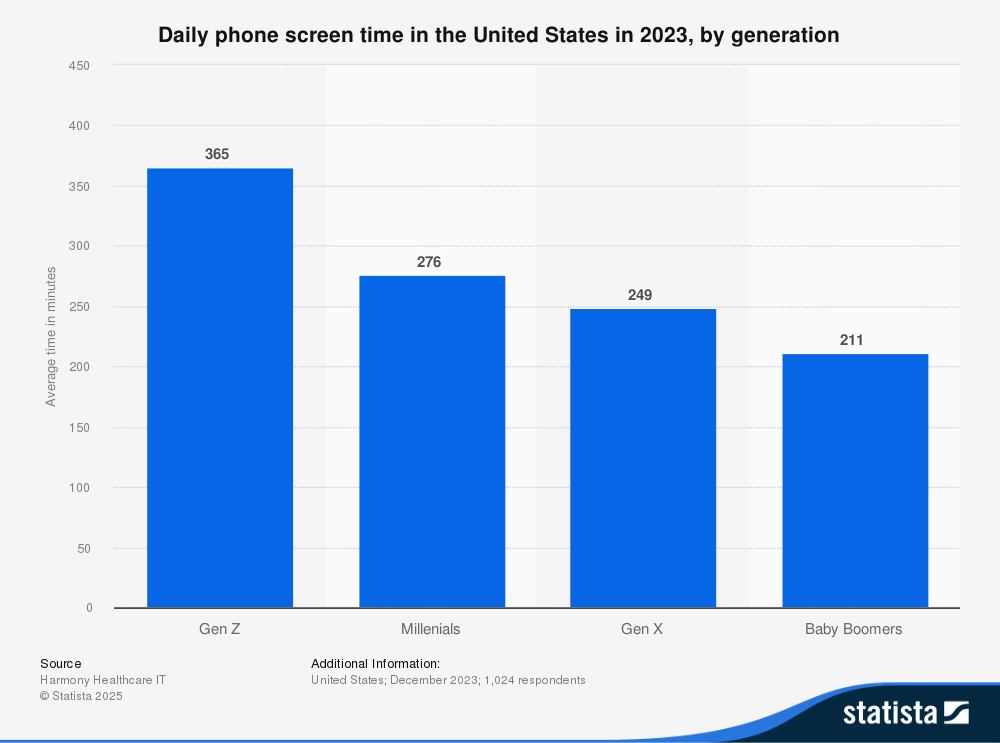
Gen Z - the youngest age group reported in this 2023 data - spends 365 minutes per day on their phone. Estimates say this is going up, and it's expected to go up further for Gen Alpha, just like it has for each generation before. We see a real increase in the net amount of attention applied. At the same time, we see machine attention augmenting it, creating almost a leverage trade on how much attention is available - how much space into a given person's mind is available.
The slop problem
The eyeballs are expanding. The people participating are making dollars. Fast, concatenated media is more popular than ever. There's only one thing that thwarts this theory: AI slop.
My elegant idea of a continuous attention expander only works if the information compression is intelligent - and apparently quite intelligent, because even the best models today still tend to output easily identifiable slop. The pre-processing has to be good enough that humans trust it. If the AI's summary is garbage, the leverage trade doesn't work.
More to come...
Okay, so what's the trade?
Long META, SNAP, GOOGL.
Long ByteDance, xAI.
| Home |